Showing posts with label Laura Benanti. Show all posts

Tuesday, December 21, 2010

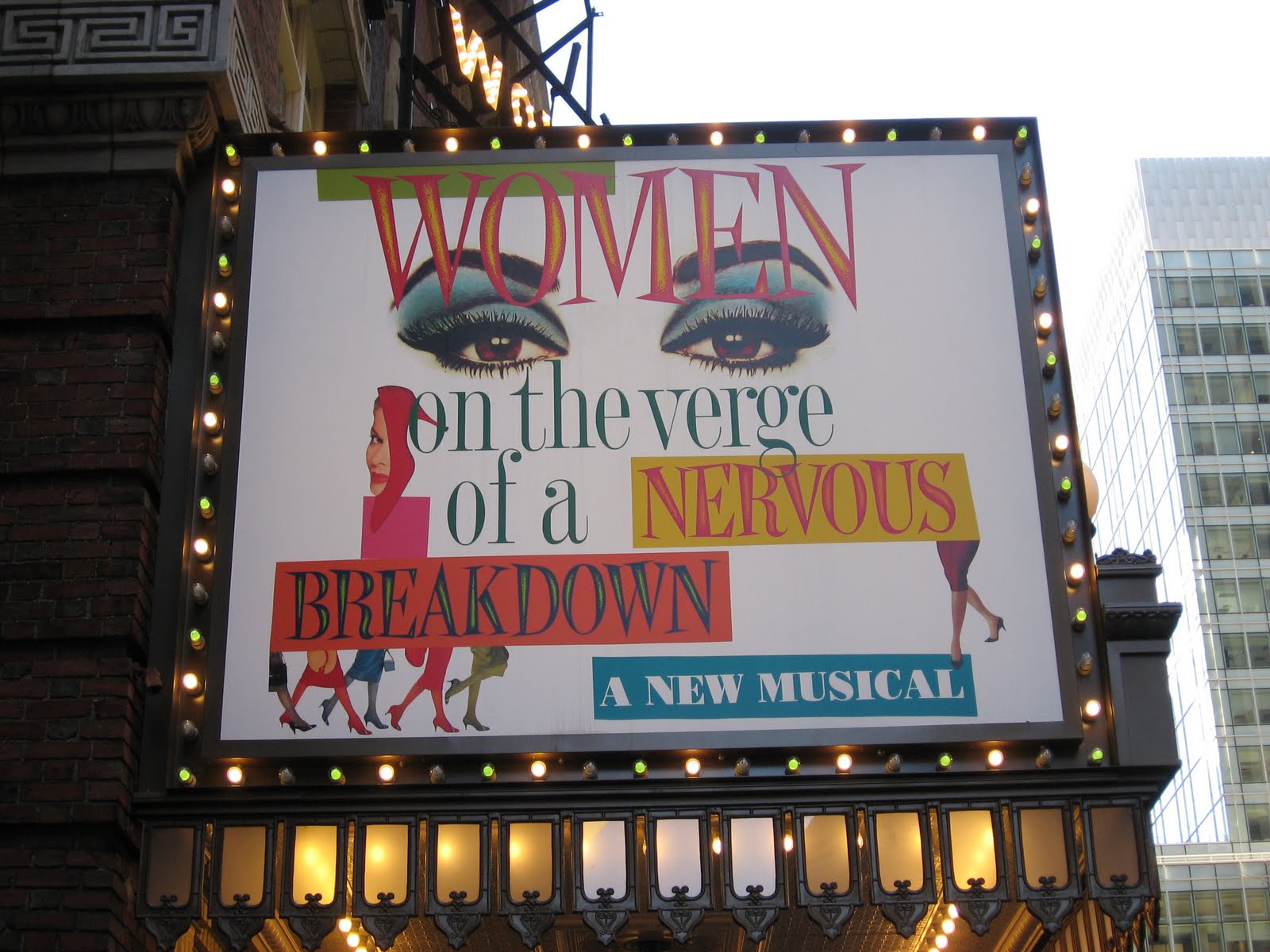
Women on the Verge of a Nervous Breakdown

Women on the Verge of a Nervous Breakdown,
at Broadway's Belasco Theatre

Gratuitous Violins rating: **1/2 out of ****


Before Women on the Verge of a Nervous Breakdown recedes to a distant memory, here's my bottom line: it wasn't a great musical but I had a good time. Seeing Patti LuPone, Laura Benanti and Brian Stokes Mitchell in the same show was a treat, even if I didn't feel totally swept up in the story.

The book, by Jeffrey Lane, is based on the Pedro Almodovar movie about a group of women in Madrid in 1987 who are driven to the breaking point by the men in their lives. While I've never seen the film I knew the musical, with a score by David Yazbek, was supposed to be a dark comedy, with over-the-top characters and a convoluted plot in the style of a telenovela.

Gazpacho also plays a big role in the musical - there's a recipe for it on the show's curtain. Since I don't speak Spanish I didn't understand all of the ingredients and the key word: frio. (It means cold, which is how the soup is served.) So the symbolism kind of escaped me.

The main character in Women on the Verge, played by Sherie Rene Scott, is Pepa, an actress who makes a living dubbing foreign films. She's distraught after her longtime boyfriend, Ivan (a very suave Mitchell), abruptly breaks up with her, via a message on her answering machine.

At the same time her good friend Candela, a frantic, not-too-bright model played by Benanti, is in a troubled relationship of her own: she fears that her boyfriend may be a terrorist, and she comes to Pepa for help.

Also in the mix are LuPone as Ivan's mentally unstable wife, Lucia; a charming Justin Guarini as Carlos, Ivan and Lucia's son; Nikka Graff Lanzarone as Marisa, Carlos' domineering fiancee; De'Adre Aziza as Paulina, a take-charge lawyer; and Mary Beth Peil as the sweet concierge in Pepa's apartment building. There's also Danny Burstein as the helpful taxi driver who chauffeurs Pepa around town.

Unfortunately as Pepa, Scott doesn't really stand out in this ensemble and I felt she was miscast. Her performance seemed a little flat, while everyone else was operating at a faster speed, more zany and memorable. Although she does have a nice solo number, "Mother's Day," that I thought was poignant.

In contrast, Benanti was an absolute delight as Candela. She was hilarious and truly seemed to capture the outrageous style that I was expecting from the musical. She made the story interesting and exciting to watch in a way that Pepa never did for me.

I also liked LuPone, whose Lucia lurked in the background, disguised in a series of large hats as she searched for Ivan. It was funny and at the same time, a sad story about an abandoned wife. Of course she has a big solo, "Invisible," which the audience ate up, myself included.

As the smooth-talking Ivan, Mitchell doesn't have a lot to do but he also gets a song, "Yesterday, Tomorrow and Today." This was my first time hearing him perform live - and I have to say it was pretty incredible. What a deep, powerful voice. I can't believe he's the same actor I used to watch as Dr. "Jackpot" Jackson on Trapper John M.D.

Despite a terrific performance from Benanti and the thrill of hearing Mitchell and LuPone, Women on the Verge seemed to be lacking something. I was entertained but I wasn't captivated. I don't know, maybe Bartlett Sher wasn't the right director for this musical. Maybe it just wasn't wacky enough.

Yazbek's score didn't leave a lasting impression and despite Burstein's opening number, "Madrid," I didn't feel transported to the Spanish capital or like I was in some kind of English-language version of a Spanish soap opera. (The song is a lively ensemble number that's supposed to set the tone but it contains some cringe-worthy lyrics involving mother's milk.)

In the Playbill, Almodovar says his films from the 1980s, coming a decade after the establishment of democracy in Spain, "reflect that explosion of freedom which illuminated everything. You could say that even grief was joyful."

Grief and joy sprinkled with a touch of craziness against the backdrop of Spain emerging from dictatorship. I get it. Unfortunately, I don't think the musical version of Women on the Verge of a Nervous Breakdown truly got it.

Friday, November 5, 2010

On the verge of a trip to Broadway

I got a sinking feeling reading the reviews last night for Women on the Verge of A Nervous Breakdown knowing that I have a ticket to see a Broadway musical widely considered a mess.

It's one of 11 shows - 10 on Broadway and 1 off-Broadway - that I'll be taking in during my two trips to New York City this month.

For an out-of-towner, especially one who can't get to the city that often, the selection process can be a gamble. Sometimes I have friends who've seen a show and rave about it. Sometimes I'm making my decisions before opening night or even before previews begin.

Honestly, I'm not sure how I'll feel about my choices by the end of November or whether the results will affect my next round of theatergoing.

While I use discounts, I'll pay full price if I think a better seat is worth it. And my aging knees require the extra leg room in the orchestra section. So we're not talking about an inconsequential amount of money.

Fortunately, I'm in a situation where I could just eat the ticket and go see something else that got a better reception from the critics. It's not going to break the bank.

Maybe it's me putting on a brave face but despite the pans, I'm still curious about Women on the Verge - if only to see for myself what everyone's talking about. I'm still looking forward to seeing Patti LuPone and Laura Benanti onstage again. I will do my best to sit back and enjoy myself. I will NOT have a nervous breakdown over it.

Picking a show is a tough decision for a tourist. Do you go with the safe choice or do you take a chance? I hope I'm always willing and able to take a chance. That's part of the excitement of being a theatre fan - and sometimes the disappointment.

And I'm pretty easy to please. Being in New York City, on vacation and away from the responsibilities of daily life, is always a treat for me. A show has to try really hard for me not to be entertained.

I love being in New York and I love going to Broadway. If Women on the Verge doesn't work for me well, it's an opportunity to hone my critical skills and see why - and to be part of the conversation.

Sunday, December 14, 2008

An early closing for Gypsy

I just read, via a Twitter from Broadway & Me, that Gypsy is closing Jan. 11. The last performance had been scheduled for March 1, but producer Roger Berlind told Broadway World that "due to these uncertain financial times" he and his partners made the difficult decision to shutter the musical early.

Last week, Gypsy was playing to 64 percent capacity at the St. James Theatre and with winter being a traditionally slow time on Broadway, the decision to close a couple months earlier than planned is understandable. Still, it's so sad.

I had the pleasure of seeing Patti LuPone, Laura Benanti and Boyd Gaines twice - in July 2007 at City Center as part of Encores and in the spring on Broadway. I loved this production of Gypsy the first time I saw it, and I think it got even better the second time, with the three leads accompanied by a wonderful supporting cast and 25-piece orchestra on stage.

This was the first Gypsy I've ever seen on stage and it was a thrilling experience. I'll always remember the standing ovation we gave Patti at City Center after she finished "Everything's Coming Up Roses." I'd never been part of a standing ovation for a song before. I turned to the person next to me and said, "that was incredible." He responded, "Just wait."

LuPone was so fierce as Mamma Rose, watching Benanti's Louise transform from gawky teenager to elegant stripper was amazing and Gaines made a truly sympathetic and heartbreaking Herbie. Their Tony-winning performances are three of the best I've seen in my brief theatergoing career. Most likely, they'll be three of the best performances I'll ever see.

Sunday, April 6, 2008

Gypsy

The first time I ever saw Gypsy on stage was last summer in New York, as part of the City Center Encores series. Even a musical theater novice like myself could see that the transformation of Laura Benanti from plain-Jane Louise to glamorous burlesque performer and stripper Gypsy Rose Lee was stunning. Last Sunday, I saw Gypsy again, at Broadway's St. James Theatre, and it was even better.

When you're writing about Gypsy, it seems more traditional to talk first about Mamma Rose rather than June and Louise - the daughters she tries, with singleminded devotion and all the subtlety of a bulldozer, to mold into stars. In fact, people seem to refer to the various incarnations over the years by who played Rose: the 1959 orginal, with Ethel Merman, followed by revivals in 1974 with Angela Lansbury, 1989 with Tyne Daly and 2003 with Bernadette Peters. I looked up the credits for those productions and I've never even heard of any of the actresses who played Louise.

Mamma Rose is such a strong, overwhelming presence from the moment she comes marching down the aisle and onto the stage. Even though the musical is called Gypsy, and based on her daughter's memoir, in many ways it's Rose's story. And Patti LuPone is a powerhouse in the role. But while I'd never seen LuPone on stage, I certainly knew of her. Even though I wasn't really familiar with her as a singer, I knew and loved her from the television series Life Goes On in the early '90s.

Benanti, on the other hand, was pretty much an unknown quantity. I knew her from the Broadway cast recording of The Wedding Singer, but I'd never seen her perform. Over the past year, I've watched more than a few shows in which a character goes on a life-transforming journey. But I can't think of another one quite as terrific as Louise's in Gypsy. Yes, there's something thrilling and chilling hearing LuPone belt out Gypsy's classic numbers. But there's something about Benanti's portrayal that just totally blew me away.

At the start of the show, Louise, her hair in pigtails, wearing slightly baggy, boyish clothes, looks kind of like a tomboy. She knows she's not the daughter that Mamma Rose is preparing for stardom, that's reserved for Leigh Ann Larkin's June, the supposedly prettier, more talented sister. But when June, having had enough of her domineering mother, heads off to make her own way in the world, Mamma turns to Louise. Now, she'll be the daughter who becomes a star. Louise's first attempts at that role are kind of awkward. The way Benanti moves and speaks conveys a sense of tentativeness and insecurity.

By the end, with her hair up, wearing makeup and dressed in evening clothes, Benanti's Louise has become a different person to go with her new name. Major credit belongs to the great costumes by Martin Pakledinaz, wig and hair design by Paul Huntley and makeup by Angelina Avallone. I almost felt like I was seeing a completely different person on stage, the transformation was so dramatic and complete.

But it's more than just nicer clothes, hair and makeup. By the end of the musical, even Louise's personality has changed. And this inner transformation is Benanti's alone. Seeing her on stage as a stripper, she's funny, teasing, sexy and radiant. In her dressing room, with Mamma Rose, she's confident and assertive. It's truly a remarkable performance, and I could watch it again and again.

One of the things I appreciate most about Gypsy is that while it may be nearly 50 years old, the plot, about the ultimate stage mother, still seems so relevant. It's as current as preschool beauty pageant contestants, preteen athletic phenoms, starlets and singers, or even the latest spelling prodigy. It's about the expectations parents have for their children, how they sometimes measure their own success by their children's achievement, and the resentment that is often created as a result.

As Mamma Rose, LuPone embodies every parent who ever tried to live their life through their children out of a misguided sense that they're doing the right thing, out of a desire to give their children the advantages and career that they were denied. I think it's a role that could easily fall into an over-the-top performance, a Joan Crawford Mommie Dearest "no more wire hangers" caricature.

But LuPone is so skillful that she makes Rose a tragic, yet sympathetic character. She wants so much for her daughters to have what she didn't have that she loses sight of what they want. She pushes a man who truly loves her out of her life, and in the end, when Louise doesn't need her anymore, she's left only with her own sadly unfulfilled dreams.

I loved LuPone's performance from the Encores production. But I think she's even kicked it up a notch for Broadway. She seemed even more determined this time to make her daughters stars no matter what. She seemed more obsessive, more everything, and it makes the ending even sadder.

Watching LuPone "act" a song is amazing. She's brilliant singing the optimism of "Everything's Coming Up Roses" that ends Act I. When the song got a standing ovation over the summer, I turned to the person next to me and said, "That was incredible." "Just wait," he advised me, "Just wait." He was right. With the finale of "Rose's Turn," when Mamma Rose asks why she couldn't have been a star, the anguish on her face is so real and so devastating and so unforgettable. LuPone's rendition was even more powerful than I remembered from the first time.

In fact, everything is as good or better on Broadway as it was over the summer. The funny songs, like "Have an eggroll, Mr. Goldstone," seemed funnier. The advice that Louise gets in "You Gotta Get a Gimmick," performed by strippers Tessie Tura (Alison Fraser), Mazeppa (Lenora Nemetz) and Electra (Marilyn Caskey), seemed even more hilarious.

And Boyd Gaines, as Rose's long-suffering companion, Herbie, is wonderful. This time, he seemed even more enchanted and exasperated by her, and in the end, even more hurt when she couldn't stop being the stage mother long enough to marry him. I felt so sorry for this dignified, decent man who wanted nothing more than to make a home for Rose and her daughters, and who didn't deserve to be treated with such disdain.

I can certainly see why Gypsy is considered a classic. The book by Arthur Laurents has so many strong, interesting characters. When I think about shows I didn't enjoy as much, it's because the characters haven't drawn me in, haven't engaged me. I simply didn't care about them as much. There's no chance of that with Gypsy. The words and music, by Stephen Sondheim and the late Jule Styne are sweet and funny and tender and rich. When you hear songs like "Everything's Coming Up Roses" and "Rose's Turn" played by a 25-piece orchestra on stage, it's pretty powerful.

While Gypsy isn't my favorite musical - there are simply too many others that I love equally - it certainly has become one of my favorites, and one of my most unforgettable experiences at the theatre.

Monday, March 24, 2008

Times three


Ok, I've been a little neglectful of my blogging over the weekend. But even when I'm not writing about the theater, I am reading and thinking about it. And I did read some great theater stories in the New York Times that I want to mention.

A profile of Laura Benanti. I'm the first to admit that I can be more than a little bit starstruck. I was really looking forward to Patti LuPone in last summer's Encores production of Gypsy, and I knew she wouldn't disappoint. But I didn't know what to expect from Laura Benanti as Louise. The way Benanti transformed herself from a gawky, insecure adolescent into a stunning, confident stripper has really stayed with me. I'm looking forward to seeing her in the role again on Sunday.

Until I read Celia McGee's profile, I didn't know anything about Ms. Benanti. It was interesting to read that to portray Louise, she taps into the loneliness she felt as a child growing up in New Jersey. And I didn't realize that she fractured her neck playing Cinderella in the 2002 production of Into the Woods. Obviously, it was an incredibly scary experience. She was partially paralyzed at times and had to undergo an operation that could have damaged her voice. But fortunately, Benanti is doing fine now. “I can walk, and I can sing, and I am healthy for the first time in a long time,” she told McGee.

Broadway shows for kids. Robin Pogrebin writes about taking her 11-year-old son and 9-year-old daughter to see musicals beyond the usual Disney fare, ones that weren't especially written for children their age but which they might like. I was happy to read that her son enjoyed Curtains: "I loved the mystery of it." And I'm especially excited about seeing In the Heights, which he called "almost flawless."

But there's one pretty child-friendly play I'd like to recommend: The 39 Steps, the British import now in an open-ended run at the Cort Theatre. Yes, it does help immensely if you've seen the 1935 Alfred Hitchcock movie beforehand. But it's so funny, with so much inspired, physical humor, that I think anyone from a preteen on up would enjoy it. And it's good to let the kids know that they can enjoy an action-adventure story without anything getting blown up.

And if I could just recommend one non-Disney musical, it would probably be Hairspray. I haven't seen it on Broadway, only on tour. I'm a big fan of its catchy pop score and I love the story. It's about teenagers and fitting in and standing up for what you believe in. Plus, it's a truly integrated musical. As the decades go by, the civil-rights movement is a period that we're dangerously close to forgetting. Hairspray tells that story in such an engaging, fun way that never sounds preachy.

South Pacific and Gypsy: Both of these are on my weekend schedule, so it was interesting to read Charles Isherwood's take on what he calls the two "theatrical bookends of the 1950s." Isherwood believes that they have quite a bit to say about the distance American musical theatre traveled in that 10-year span.

I'd never thought of the two shows that way - contrasting South Pacific and its more optimistic message with Gypsy as a harbinger of darker themes to come in American society. Isherwood concludes that while he loves Momma Rose, American audiences today may be more in the mood for what South Pacific dishes up.