Showing posts with label Steve Jobs. Show all posts

Saturday, October 29, 2011

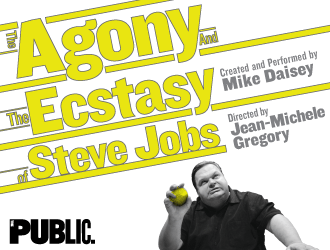
The Agony and the Ecstasy of Steve Jobs

The Agony and the Ecstasy of Steve Jobs, at the Public Theater
Gratuitous Violins rating: ***1/2 out of ****


I've never seen anything quite like The Agony and the Ecstasy of Steve Jobs. A monologue from Mike Daisey, it demolishes theatre's imaginary "fourth wall" to directly challenge the audience. Its purpose is to entertain but also to provoke.

Daisey sits at a table with no props, no audio or visual aids except for some bars of white lights behind him that flash once in awhile. All he has is a glass of water and some sheets of legal-sized notepaper, which I didn't even see him referring to very often.

Interestingly, he uses a low-tech way to tell a high-tech story, mixing his history as an Apple fanboy with his experiences traveling to the factory in China where iPods, iPhones and iPads are assembled. You're just listening to him talk for nearly two hours - the oldest form of storytelling there is. The result is vivid and absorbing.

The centerpiece is Daisey's visit to the Foxconn plant in Shenzhen, China. Foxconn is the world's largest maker of electronic components and it works under contract for many companies, including Apple. There have been numerous reports about long workdays, injuries, cramped living conditions and a spate of suicides. He recounts it all in heart-wrenching detail.

Along the way, Daisey raises questions about Apple's closed operating system, which keeps a tight rein on developers, how we're all so eager to upgrade our software and hardware whenever a new version comes out - whether we need it or not. And he points out how ignorant we are of the conditions under which the gadgets we love are made.

To be honest, he isn't telling us anything we don't already know: Steve Jobs was arrogant, working in a factory is repetitive and mind-numbing and in the West, we've turned a blind eye toward how China treats its citizens. But the way he puts it together is compelling. I bought my first Apple product in 1990 and I've been a fangirl ever since, and it made me uneasy.

There were some elements of Daisey's storytelling that I didn't really like. The unrelenting f-bombs felt unnecessary. He had a habit of raising his voice at the beginning of a sentence then lowering it, which got a bit annoying. I know some of that is necessary. He's acting, not delivering a speech. But it made me wonder how much of his story was embellished. We're paying $80 for a ticket. We want drama, emotion, conflict.

I don't doubt that conditions in China are as bad as Daisey portrays them. But I couldn't believe that the Foxconn workers were so willing to talk to him (through an interpreter). China is, after all, a repressive, totalitarian country. And Daisey is a performer, not a journalist. Plays, like TV and movies, are allowed to take artistic liberties.

Daisey has performed this piece before and the engagement at the Public Theater was announced long before Jobs died earlier this month. I wondered whether he would soften his criticism of the Apple cofounder but he doesn't let up, saying that Jobs went to his death knowing about the conditions in the Chinese factory and did nothing. That felt a little harsh, like he was intentionally piling it on about someone who died so recently.

I don't think that The Agony and the Ecstasy of Steve Jobs will make anyone stop buying Apple products. What's the alternative? Foxconn's clients include just about every maker of computers and cell phones. And the stock of those companies is likely in the mutual funds that are part of most of our retirement plans.

But Daisey is a great storyteller and he does what theatre should do: entertain, make you think, take you to a place you've never been. And when you leave, you get a sheet of paper with some suggestions for further steps you can take, including e-mail Apple CEO Tim Cook (tcook@apple.com).

Daisey says that he focuses on Apple because it's an industry leader but he acknowledges that the issue goes deeper: "We do not like to think about our relationship with China and the true cost of our labor, but that silence can only exist if we are complicit with it."

By presenting the issue in such starkly human terms, Daisey accomplishes one thing with The Agony and the Ecstasy of Steve Jobs: He made me think about where my stuff comes from in a way that I never had to do before.

Thursday, October 6, 2011

Steve Jobs, 1955-2011

When I found out yesterday - reading a news bulletin on my iMac - that Apple cofounder Steve Jobs had died, it hit me hard.

It's not just that Jobs passed away much too young, at age 56 of pancreatic cancer. Thinking about what all of those sleek and shiny iMacs, iPods and iPhones have allowed me to do in the 21 years since I purchased my first Apple computer is mind-boggling.

I took a class in college on the computer programming language BASIC and it was not a wise move. So back in December 1990, the thought of owning a personal computer was daunting. But Apple made it easy and elegant and fun.

Here's a brief trip through my Apple fangirl history:

Macintosh Classic: Truthfully, I couldn't do much with it. The World Wide Web hadn't even been born yet. I played a lot of games: Railroad Tycoon, Sim City, Where in the World is Carmen Sandiego. If they made an Apple version, I bought it. You couldn't be too choosy.

Macintosh Performa. This was a big step up, it had a bigger monitor and I think it was color. I was on Prodigy for awhile, then America Online. It was considered much too scary to go onto the Internet without someone holding your hand. And remember newsgroups? Are they still around? I used to read them a lot.

PowerBook: My first laptop, which I bought when I moved to Israel for a year. I remember the thrill at finding my first freelance article online. I realized that my audience wasn't limited to people who had a physical product in front of them. Anyone, anywhere in the world could read something that I'd written.

iMac: My first "i" purchase. Goodbye floppy drive, hello CD-ROM. This was where I first uploaded my entire music collection onto iTunes, then onto my first iPod, downloaded my first podcasts, wrote my first blog posts. I got a good 10 years worth of use out of it before it just got too slow.

iPhone: I never thought I'd need to carry around a personal computer in my pocket. Then for a couple of weeks this year, I was housebound without Internet or cable. I used it for e-mail, to check Twitter and Facebook. I read the New York Times, listened to music and streamed movies. It was my link to the outside world.

Like I wrote in August when Steve Jobs stepped down as CEO, his genius was in coming up with products that you never think you'll want but once you have them, you can't imagine ever living without them.

Wednesday, August 24, 2011

Steve Jobs resigns as Apple CEO

I was so sad to hear that Steve Jobs is resigning as CEO of Apple, above all for what it may mean about his health. Jobs, 56, has been fighting pancreatic cancer for years and had a liver transplant in 2009. He's been on medical leave since January.

In his resignation letter, he stated "I have always said if there ever came a day when I could no longer meet my duties and expectations as Apple’s CEO, I would be the first to let you know. Unfortunately, that day has come."

I bought my first Mac in December 1990, when the company's market share was in the single digits. There were no shiny Apple stores where you could check your e-mail and play with the newest toys. If you wanted software or accessories, you had to order them by mail.

At the time, I probably didn't really need a personal computer. There wasn't much you could do with one except play games and use it as as word processor. Online services like Prodigy let you send e-mail -- to other people on Prodigy.

But I'd just finished a freelance writing assignment and figured if I got more, I didn't want to keep banging them out on an electric typewriter. It was years before I did any more freelance writing but since then, I've had six Apple computers.

This year, another device that I never thought I would need came close to well, if it didn't actually save my life it definitely preserved my sanity.

For a couple of weeks when I was pretty much housebound -- without an Internet connection or cable TV -- my iPhone was my connection to the outside world.

I've been thinking of all the ways I used it -- keeping in touch via e-mail, checking up on Facebook and Twitter, reading The New York Times and listening to music and podcasts. I even used my Netflix app to stream the first season of Parks and Recreation.

I still have my Macintosh Classic with 2 megabytes of RAM, a 9-inch black and white screen and a 390-page spiral-bound user's manual. I paid $1,499 for it and I rarely had to crack open the manual, it was so easy to use. When I bought my iPhone last year, it came with 8 gigabytes of RAM -- that's 8,192 megabytes -- and it cost me under $100.

I think that's part of the genius of Apple -- to come up with products you never think you'll want and then once you have them, you can't imagine ever living without them. I mean, why would I need to carry around what's basically a mini computer? But it's my favorite Apple gadget of all.

For a brief period last month, Apple became the most valuable company in the world in terms of market capitalization. That's an incredible accomplishment compared with where it was back in the 1990s.

I wish Steve Jobs the best. In his letter, he said that Apple's brightest and most innovative days are ahead and he looks forward to contributing in a new role. I'm sure they are and I hope that he does.