Showing posts with label Public Theater. Show all posts

Thursday, August 16, 2012

Into the Woods


Into the Woods, at the Delacorte Theater in Central Park
Gratuitous Violins rating: ***1/2 out of ****

For me Into the Woods was more than a show, it was a practically 24-hour experience that I can't judge solely by what I saw onstage.

From 5:30 a.m., when I got to Central Park to stand in line for a free ticket, until the curtain call shortly after 11 that night at the Delacorte Theater, it turned out to be one of my most memorable New York City days ever.

Initially, I wasn't enthusiastic about getting up before dawn but my friend Tapeworthy assured me that it would be fun. And you know what, he was right. I couldn't have asked for a better first visit to the Public Theater's Shakespeare Sondheim in the Park.

I spent seven hours watching the park come alive on a sunny Friday morning. I was with wonderful friends I've met through theatergoing. We had breakfast and lunch delivered. I ended up with a front-row seat. And despite my obsessive worrying, not one drop of rain fell.

I'll admit that Into the Woods isn't my favorite Stephen Sondheim musical. It's about 3 hours and near the end, I was feeling the length. There's a lot going on in James Lapine's book of overlapping fairy tales - a baker and his wife, Little Red Riding Hood, Cinderella, Jack and the Beanstalk, and maybe some others I missed. I think some of the deeper meaning went by me.

This production, which originated at London's Regent's Park, uses a child narrator instead of an adult. But because I didn't know any better, I just assumed the role was supposed to be a child's. I imagined this young boy having problems at home and he's run away. He ends up lost in the woods and has this dream/nightmare that's a mishmash of stories he's been told.

I was thrilled by the magical elements: the Witch's transformation, the Giant, voiced by Glenn Close, appearing in a corner of the sky, the sprouting beanstalks. I liked the multi-tiered treehouse set designed by John Lee Beatty that blended in with the park's natural woods. Although I can see where it wouldn't be nearly as much fun if you were sitting off to the side or to the back.

I attended the third preview, so I realize that things were still jelling. But I thought Denis O'Hare and Amy Adams were sweet the Baker and his Wife. Their quest for a child was touching. Although Adams, whose film work I've loved, didn't make as big an impression onstage as I'd hoped. Donna Murphy was a great menacing presence as the Witch.

But four performances really stood out for me.

Sarah Stiles as Little Red Riding Hood and Ivan Hernandez as the Wolf were sexy and hilarious. As Cinderella, Jessie Mueller had such a gorgeous voice, especially in "No One Is Alone," that I wish she'd had a bigger role. And Gideon Glick was so endearing as Jack. I loved his "Giants in the Sky."

My favorite part of Into the Woods was simply being in Central Park at night for the first time.

I don't think I've ever seen any theatre outdoors before and it was lovely. You don't feel like you're in a crowded, concrete island of 1.6 million people but out in the woods somewhere. I always want to be transported by what I see onstage but this took it to a whole different level. (My only criticism: I wish there had been better lighting outside the theater when we left.)

Maybe if I'd spent $150 to see the show on Broadway I might feel differently. And honestly, I'm not sure there's a big Broadway audience for this unless it has a big Hollywood star. Despite the subject matter, it's not for kids. But the day was so perfect - a terrific introduction to a now 50-year-old New York City summertime tradition.

In short, it was the kind of day the late Joseph Papp, founder of the Public Theater and Shakespeare in the Park, might have had in mind when he said, "Part of the spiritual life of the city is its art."

Saturday, October 29, 2011

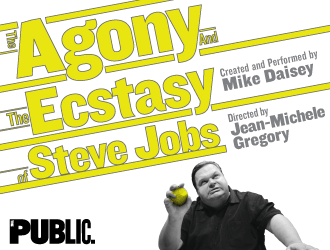
The Agony and the Ecstasy of Steve Jobs

The Agony and the Ecstasy of Steve Jobs, at the Public Theater
Gratuitous Violins rating: ***1/2 out of ****


I've never seen anything quite like The Agony and the Ecstasy of Steve Jobs. A monologue from Mike Daisey, it demolishes theatre's imaginary "fourth wall" to directly challenge the audience. Its purpose is to entertain but also to provoke.

Daisey sits at a table with no props, no audio or visual aids except for some bars of white lights behind him that flash once in awhile. All he has is a glass of water and some sheets of legal-sized notepaper, which I didn't even see him referring to very often.

Interestingly, he uses a low-tech way to tell a high-tech story, mixing his history as an Apple fanboy with his experiences traveling to the factory in China where iPods, iPhones and iPads are assembled. You're just listening to him talk for nearly two hours - the oldest form of storytelling there is. The result is vivid and absorbing.

The centerpiece is Daisey's visit to the Foxconn plant in Shenzhen, China. Foxconn is the world's largest maker of electronic components and it works under contract for many companies, including Apple. There have been numerous reports about long workdays, injuries, cramped living conditions and a spate of suicides. He recounts it all in heart-wrenching detail.

Along the way, Daisey raises questions about Apple's closed operating system, which keeps a tight rein on developers, how we're all so eager to upgrade our software and hardware whenever a new version comes out - whether we need it or not. And he points out how ignorant we are of the conditions under which the gadgets we love are made.

To be honest, he isn't telling us anything we don't already know: Steve Jobs was arrogant, working in a factory is repetitive and mind-numbing and in the West, we've turned a blind eye toward how China treats its citizens. But the way he puts it together is compelling. I bought my first Apple product in 1990 and I've been a fangirl ever since, and it made me uneasy.

There were some elements of Daisey's storytelling that I didn't really like. The unrelenting f-bombs felt unnecessary. He had a habit of raising his voice at the beginning of a sentence then lowering it, which got a bit annoying. I know some of that is necessary. He's acting, not delivering a speech. But it made me wonder how much of his story was embellished. We're paying $80 for a ticket. We want drama, emotion, conflict.

I don't doubt that conditions in China are as bad as Daisey portrays them. But I couldn't believe that the Foxconn workers were so willing to talk to him (through an interpreter). China is, after all, a repressive, totalitarian country. And Daisey is a performer, not a journalist. Plays, like TV and movies, are allowed to take artistic liberties.

Daisey has performed this piece before and the engagement at the Public Theater was announced long before Jobs died earlier this month. I wondered whether he would soften his criticism of the Apple cofounder but he doesn't let up, saying that Jobs went to his death knowing about the conditions in the Chinese factory and did nothing. That felt a little harsh, like he was intentionally piling it on about someone who died so recently.

I don't think that The Agony and the Ecstasy of Steve Jobs will make anyone stop buying Apple products. What's the alternative? Foxconn's clients include just about every maker of computers and cell phones. And the stock of those companies is likely in the mutual funds that are part of most of our retirement plans.

But Daisey is a great storyteller and he does what theatre should do: entertain, make you think, take you to a place you've never been. And when you leave, you get a sheet of paper with some suggestions for further steps you can take, including e-mail Apple CEO Tim Cook (tcook@apple.com).

Daisey says that he focuses on Apple because it's an industry leader but he acknowledges that the issue goes deeper: "We do not like to think about our relationship with China and the true cost of our labor, but that silence can only exist if we are complicit with it."

By presenting the issue in such starkly human terms, Daisey accomplishes one thing with The Agony and the Ecstasy of Steve Jobs: He made me think about where my stuff comes from in a way that I never had to do before.

Tuesday, August 3, 2010

Music for marriage equality

I love checking off new experiences during my trips to New York. This time, I made my first visit to Joe's Pub, named after Public Theater founder Joe Papp, for the Broadway Impact concert with cast members from American Idiot.

I haven't seen the musical so it was nice to hear new performers like Christina Sajous, above, and familiar ones, like Rebecca Naomi Jones, who was in Passing Strange on Broadway.

It was a fun way to end the weekend and at $25 for a ticket, very reasonable. I'm glad my fellow blogger Linda, from Pataphysical Science, invited me to go along. (Although be warned that not all cast members participate and they don't necessarily sing songs from the show.)

While I got a little squished in the packed bar (tables go fast) I was happy to be part of a crowd supporting Broadway Impact. It's a community of actors, directors, stage managers, fans - anybody who's ever worked on or been to a Broadway show - united in the fight for marriage equality.

If I never went to the theatre I'd still support marriage equality - for my friends and because it's the right thing, the American thing, to do.

But being a theatre fan makes it more personal. How can I tell people whose work I admire - onstage and behind the scenes - that if they're gay or lesbian, they shouldn't be allowed to marry the person they love?

Tickets are on sale for the final Broadway Impact concert of the summer at Joe's Pub, at 7 p.m. Aug. 23, featuring cast members from the Tony-winning musical Memphis.

I can't think of a more fitting finale than Memphis, in which a white dj and a black singer fall in love in the 1950s, when it was not only illegal for them to get married in their home state but dangerous to even be seen together as a couple.

Unfortunately, I won't be in New York City for the Memphis show but I'm looking forward to returning to Joe's Pub for another Broadway Impact concert.

It would be great if the cast of every Broadway musical agreed to do one.

Wednesday, January 20, 2010

Joe Papp on the spiritual life of the city

I'm in the middle of reading Free For All by Kenneth Turan, a terrific oral history of Joe Papp, the founder of the New York Shakespeare Festival and the Public Theater.

Turan began the project years ago as a collaboration with Papp, who died in 1991, so there are lots of quotes from him and people who knew him well. I'm clearly getting a sense of how stubborn and obnoxious Papp could be at times.

But what also comes through loud and clear is his devotion, almost with a religious fervor, to the idea that the arts, especially theatre, should be available to everyone, accessible to everyone, that they were an integral part of everyday life in New York City.

And he wasn't at all apologetic about it. Although he was prone to hyperbole: "I always used to say that Shakespeare should be as important as garbage collection."

He also said, proudly, that the Public Theater was the only institution of its size in the city that was started from the bottom by a poor boy and worked its way up. "All the other major, established institutions were started by big money."

I love this quote from Papp, which appears on page 237:

"Whenever I used to ask for money, they'd always raise the question: "The city has only $50,000 and there are kids starving to death and you're putting on Shakespeare. What's more important? What would you do?''

"Oh, shut up with that, already," I'd say. "That's a ridiculous question. In the first place, the city has more than $50,000. And, certainly, the city wastes millions and millions of dollars on things that are not important.

"In the general scale of things, certainly it's important to take care of basic necessities, to take care of the ill and the homeless, to feed children. But part of the spiritual life of the city is its art, its plays, so you are creating a false distinction.''

Monday, November 23, 2009

When Joe Papp fired Kevin Spacey

Yesterday I picked up a copy of Free for All, by Kenneth Turan, an oral history of Joseph Papp and New York's Public Theater. I've just started thumbing through it but so far, it looks pretty interesting.

I first heard Papp's name when I was a teenager. I remember watching a play from the New York Shakespeare Festival on TV and being enthralled by it. I'm fairly certain it was this production of Much Ado About Nothing that aired on CBS in 1972.

Last fall, I made my first visit to the Public, for Stephen Sondeim's Road Show. I'll admit that Sondheim wasn't the only draw. I also wanted to see the place where landmark musicals like Hair and A Chorus Line were nurtured.

And yes, there was one other important reason - Kevin Spacey worked there briefly, after dropping out of Juilliard. (There's a Kevin Spacey connection to everything!)

I don't think this story is in the book but I've heard Kevin tell it many times in interviews and it's a nice one.

Here's an account that appeared in the Oct. 24, 1999 issue of Parade magazine:

"I had no prospects, no agent, no money, nothing. Then I got an audition for the New York Shakespeare Festival in the Park by basically browbeating the casting office. I played a messenger with, like, six lines in Henry IV, Part One. It was my first job in New York as a professional actor, and it was pretty exciting, but after that I just couldn't get any acting work.

"I was working as a hat-check guy in a restaurant when I decided to see Joe Papp for a job." [Papp was the influential founder and director of the New York Shakespeare Festival. He gave Spacey a job as office help.]

"While working there, I got cast as the lead in an off-off Broadway play, The Robbers, and got my first New York review - in the Village Voice. It was extremely complimentary, because they compared me to both Marlon Brando and Karl Malden in the same sentence, so for weeks my friends called me 'Marlon Malden.'

"Joe Papp showed up at the play one night and fired me the next day. I was stunned, because it was paying my rent. Joe said, ‘I saw an actor last night onstage, and you've become too comfortable here.’ He did me the greatest favor in the world by literally shoving me out the door.

"Four months later, Joe was in the opening-night audience of my first Broadway play."

Wednesday, June 17, 2009

Words of wisdom from Carole and Oskar

I've been trying to catch up on my Playbill Radio podcasts. There are a lot I haven't listened to yet and at this point, some of the shows have opened and closed already. But these two are going strong:

I liked this quote from Carole Shelley, who plays the grandmother in Billy Elliot, as she politely declines to describe a particular scene in the musical:

"I don't really want to spoil it because I think it is one of the most stunningly choreographed pieces I have ever a., seen in my life and b., been a part of. So I would rather not say anything about it, if that's all right with you. I think surprises are the most exciting part of going to the theater."

You're right, Ms. Shelley, and I'm trying to be less spoilerish in my reviews! I know I do way too much research before I go to a show. (What can I say - I'm an information junkie. I was the type of kid who loved doing term papers.) Most of the time, knowing less is better.

Oskar Eustis, the artistic director of the Public Theater, does engage in a little hyperbole here, but I think he makes a good point about Hair's place in American popular culture. Part of the reason, of course, is that entertainment has become more diffuse. I mean, do we even have a common pop culture anymore?

"Hair is on the one hand, one could make the case it's the classic American musical. It was the last American stage show that became the soundtrack for a generation. There's been no show on stage since Hair that actually the whole country knows. Phantom of the Opera? I don't think so."

Okay, Phantom's an easy target but I bet the Public and Mr. Eustis would be happy to have Hair run on Broadway for 21 years - and counting!

Wednesday, November 19, 2008

Road Show

Gratuitous Violins rating: ***1/2 out of ****

I've always said - jokingly, I assure you - that I like to see my money up on stage. But the production of Stephen Sondheim's Road Show, which opened last night at New York City's Public Theater, takes things to a whole new level.

Over the course of 90 minutes, Wilson Mizner, played by a delightfully brash Michael Cerveris, and his more low-key brother, Addison, portrayed by Alexander Gemignani, seek their fortunes in the late 19th and early 20th century United States, and around the world. The pair walk a fine line between entrepreneur and con artist as they make and lose more money than you could possibly imagine.

No, I take that back. It's actually quite easy to imagine because money - great wads of it - is everywhere in this musical. Tossed in the air with abandon, it lands in the audience or is strewn about on stage, where it rests for the remainder of the show, as if to punctuate what this is all about.

I like drama that explores the dark underbelly of American life, and the music in Road Show reminds me a bit of Sondheim's score for Assassins. If Assassins is a meditation on our propensity for violence and our desire for fame, then Road Show is about other strains in the American character - our ability to create new identities for ourselves, our desire to strike it rich and our willingness to do anything for a buck.

The real-life Mizner brothers were born in California in the 1870s and died within weeks of each other in 1933. This is my first experience with the musical about their lives, which has had various incarnations over the past decade since its beginnings as Bounce. Apparently the current version sheds some characters, drops some songs and trims the running time. But I think the essence of the story remains.

John Weidman's book opens with their death and works backward - as their dying Papa, played by William Parry urges the brothers to go out and find their own road in life. That road, of course, is supposed to lead to the American Dream of financial success.

And Road Show, under John Doyle's snappy direction, charts every twist and turn along the way - prospecting for gold in Alaska, a fireworks factory in Hong Kong, a questionable real estate venture in Florida.

If at first they fail, and they seem to fail a lot, the Mizners simply remake themselves into something else. Along the way they're partners, they quarrel and in the end, they're inseparable. If they sometimes skirt the edge of the law, their inventiveness and daring are the same qualities that built this country.

This was my first trip to the Public and I was surprised and thrilled to find that the Newman Theater is a very intimate space - about 300 seats. Doyle's scenic design is a jumble of old wooden boxes and filing cabinets that the cast sits on - and Cerveris and Gemignani do quite a bit of jumping around on during the show.

Cerveris is terrific as Wilson Mizner, the more amoral of the brothers. He's a cad and a raconteur and a rogue. I especially loved the number that charts his successes and failures in New York City, where he's toasted as the "king of Broadway." He marries a rich widow, tries his hand at playwriting and as a boxing promoter, and probably a few other things that I've forgotten. (I wish I knew the name of the song, but there was no song list in my Playbill.) All the while he pretty much ignores his brother and poor Mama, played sweetly by Alma Cuervo, who faithfully follows his comings and goings in the society pages.

While it's a less showy role, Addison is still a pretty fascinating figure and Gemignani does a great job portraying his inner conflict. At times, he goes along with his brother's schemes and at other times, he's repulsed by them. He genuinely wants to settle down to work as an architect, building grand houses for the very rich. There's a great scene showing how each matron wants her home to be flashier and bigger than her neighbor's.

Traveling to Florida by train, Addison befriends Hollis Bessemer, played with innocence and enthusiasm by Claybourne Elder. Bessemer, whose father has disowned him for dropping out of the family business, dreams of starting a colony for artists. He and Addison become partners and lovers. They have a beautiful, stirring duet: "The Best Thing That Ever Has Happened."

Still, I couldn't quite figure out whether Addison was sincere or whether he was using Bessemer for his entre to Florida's rich and powerful. I didn't sense a great deal of chemistry between them. So I wondered whether they really were the great loves of each other's lives or whether this simply was another Mizner con. I hope not, because it's such a gorgeous song.

While Road Show has some dark moments, there's a great deal of wit and humor, with some perceptive things to say about the American character and about human nature in general. The brothers' final scheme - tempting people to buy land in the new community of Boca Raton, Fla., with the promise of an enormous return on their investment - has echoes of today's subprime mortgage crisis.

When Wilson airs a radio pitch for the project, the sound design by Dan Moses Schreier makes his voice reverberate throughout the tiny auditorium. It's a deal that's too good to be true, Sondheim is telling us, but human nature being what it is, we fall for it anyway.

Thursday, March 27, 2008

Back on Broadway

I made it! I'm in New York City - back where I belong!

I had a nice ride in on Amtrak's Acela Express, although this time it wasn't quite so express. We were 30 minutes late getting into Penn Station. But hey, I'm on vacation. I have all the time in the world!

I took a look at the line of people waiting for cabs outside the station and decided to hoof it to my hotel - about 14 blocks. It was a little chilly and drizzly, but the walk wasn't too bad. There's just something about walking as opposed to riding in a cab.

When you ride in a cab, you feel like a visitor. When you walk, you feel like you're a part of the city. And I was part of the teeming throng of humanity, as I dodged between people, dragging my suitcase, my knapsack perched precariously on top.

A couple of times, I didn't quite make it up the curb to the next street, and the knapsack and suitcase toppled over. I had to quickly get out of the way to avoid being crushed by the teeming throng of humanity.

A few blocks from my goal I stopped for a minute under the overhang of an office building to get a tissue. I looked inside the lobby and thought it looked new and modern and nice. When I was ready to go on, I stepped back and realized I had been standing right in front of - The New York Times! How cool is that!? I wanted to take a picture, but it was raining and damp and I'd only had a granola bar and a diet Pepsi since breakfast, so I trudged on.

I finally made it to my hotel, dropped my stuff off, and walked down to the Edison Coffee Shop, the site of my first Broadway meal a little over a year ago, when I came to see Kevin Spacey in A Moon for the Misbegotten. I had the same thing I ate last time - a turkey sandwich on rye. And it was real turkey, none of the foul-tasting processed deli meat you get in a lot of places. It comes with a tiny cup of coleslaw, and pickle and all of the spicy brown deli mustard you want. (And I'm a big mustard fan.)

The Edison was started after World War II by two Polish-Jewish Holocaust survivors, and it's a real Broadway hangout, or at least that's how all the framed newspaper clippings on the walls describe the place. It's frequented by producers and starving actors alike. A group of magicians gather there every week. Neil Simon even wrote a play about the Edison, called 42 Seconds from Broadway, because it is actually 42 second from the Great White Way.

Well, it's almost time to head out to the first show of my firstBroadway outing of 2008. I'm seeing the much acclaimed Passing Strange tonight. I'm really looking forward to taking a journey with rock musician Stew, and see where life leads him.

I'll report back later on whether I see the ghost of David Belasco!